Table of Contents
Hey lovely ladies! Have you ever stared at a pair of jeans online, seen both “inseam” and “outseam” sitting in the size chart, and had zero idea which number actually mattered? I’ve been there more times than I’d like to admit.
The whole inseam vs outseam question tripped me up for years. I ordered more than one pair of “straight leg” trousers that looked perfect in the photo and landed somewhere between capri and flood pants on my actual legs. Not cute.
Here’s the good news. Once you understand the difference between these two measurements, you’ll never second-guess a size chart again. I’m walking you through exactly what each one measures, how to find your own numbers at home, and which one you should actually trust when you’re shopping for bottom wear like jeans, trousers, or shorts. Let’s save you the returns.
What Is Inseam, Exactly?
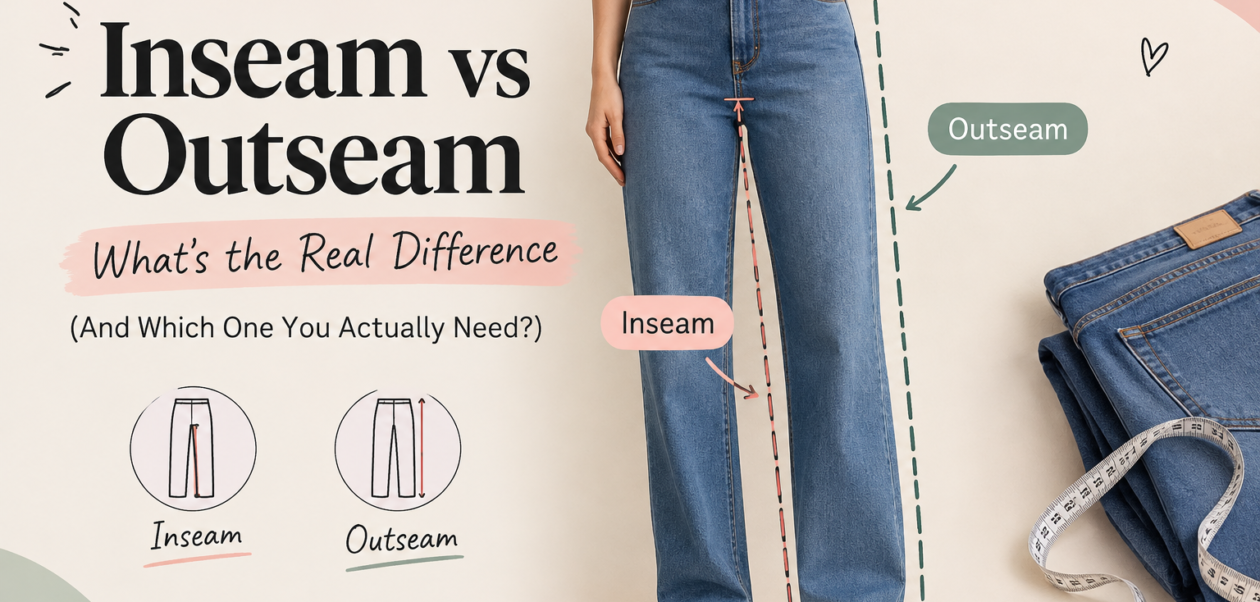
Inseam is the measurement running along the inside of your leg, from the crotch seam down to the bottom hem. It’s the number that basically tells you how long a pair of pants will be once you’ve got them zipped and buttoned.
When a brand lists “32-inch inseam” on a pair of jeans, they’re telling you the inside leg length, not the total length of the garment. This is the measurement most stores use as their default, especially for men’s slacks and unisex denim, because it’s the most consistent one. Rise and waist height can change from brand to brand, but the inseam stays a pretty reliable, straightforward number.
Here’s my honest advice: if a listing only gives you one measurement, it’s almost always the inseam. So learning your own inseam is genuinely the single most useful number you can carry around in your head while shopping.
What Is Outseam, Exactly?
Outseam is measured along the outside of the leg, starting at the top of the waistband and running all the way down to the hem. Because it starts at the waist instead of the crotch, outseam includes something inseam doesn’t: the rise.
Rise is the distance from the crotch to the top of the waistband, and it’s exactly why two pairs of pants with the same inseam can feel like completely different lengths on your body. A high-rise pair and a low-rise pair with an identical 30-inch inseam will have noticeably different outseams, because the low-rise pair simply has less fabric between your waist and your hips.
Outseam shows up less often in women’s sizing, but it matters a lot more than people realize once you’re comparing styles like wide-leg trousers, high-waisted mom jeans, or a low-rise vintage cut. If you’ve ever wondered why your “usual size” felt off in a different silhouette within the broader world of types of clothing, the outseam is often the quiet culprit.
Inseam vs Outseam: The Key Differences
Let’s put this side by side, because I think a visual just makes it click faster.
| Inseam | Outseam | |
| Where it starts | Crotch seam | Top of waistband |
| Where it ends | Bottom hem | Bottom hem |
| Includes the rise? | No | Yes |
| Most commonly used for | Jeans, trousers, sizing charts | Comparing total garment length, tailoring, shorts |
| How consistent it is | Very consistent across styles | Varies a lot depending on rise and cut |
| Typical women’s range | 26″–34″ | 34″–42″ |
The bottom line is this: inseam tells you how long your legs need to be covered, and outseam tells you the full story of the garment from waist to hem. If you only remember one thing from this whole guide, remember that outseam is basically inseam plus rise.
How to Measure Your Inseam at Home
You don’t need a tailor for this one, I promise. Grab a pair of pants that already fit you well and a soft measuring tape.
- Lay the pants flat on a table or the floor, front side up, with the legs smoothed out so there aren’t any wrinkles or folds.
- Find the crotch seam. It’s the point where the front and back seams meet.
- Starting right at that seam, run the tape measure straight down the inside of the leg to the bottom hem.
- Write that number down in inches. That’s your inseam.
If you’d rather measure yourself directly instead of a pair of pants, stand barefoot against a wall and have a friend hold the tape from the very top of your inner thigh down to the floor. It’s genuinely hard to do solo and get an accurate read, so recruit a friend or your partner for this one.
How to Measure Your Outseam at Home
Same tape measure, slightly different starting point.
- Lay your pants flat again, front facing up.
- Start at the very top of the waistband, right along the outer side seam.
- Run the tape measure down that outer seam all the way to the hem.
- That total is your outseam.
A quick gut check: your outseam should always be longer than your inseam on the same pair of pants, since it’s covering more territory (waist to hem instead of crotch to hem). If your numbers come out reversed, re-measure. Something’s off.
Why the Same Pants Can Have Different Outseams
This is the part that used to genuinely confuse me. I once owned two pairs of “32-inch inseam” jeans from different brands that fit my ankle at completely different points. Turns out, inseam only tells part of the story.
Fabric weight plays a role here too, which is honestly something I didn’t think about until I started paying attention to fabric GSM on clothing tags. A heavier, structured denim holds its shape and drapes straight down, while a lighter, stretchier fabric can pull up slightly with movement and change how the hem sits by the end of the day.
Cut matters just as much. A skinny jean, a bootcut, and a wide-leg trouser can share the exact same inseam number and still look totally different lengths on your body, because the silhouette around your calf changes where your eye lands. This is the same logic that separates two similar-looking bottoms, like the fit distinction I broke down in my chinos vs khakis comparison. Small structural differences add up to a very different fit.
Inseam Length Chart for Petite, Regular, and Tall Women
I get asked constantly what inseam actually “counts” as petite, regular, or tall. Here’s a starting point, though I’ll be honest with you: these are guidelines, not rules. Your proportions matter more than a general height bracket.
Petite (Under 5’4″)
A petite frame typically does best with a 26 to 29-inch inseam for full-length pants, and around 24 to 26 inches for a cropped style. If you’re petite and you love a wide-leg trouser, size down in inseam before you size down in waist. I’ve made that mistake and ended up hemming a perfectly good waist fit.
Regular (5’4″ to 5’8″)
This is the widest range, generally 29 to 32 inches for full-length pants. Most off-the-rack “regular” lengths from brands like J.Crew, Old Navy, and Uniqlo are built around this bracket, which is honestly why regular-height shoppers tend to have the easiest time finding pants that just work straight off the hanger.
Tall (5’8″ and Up)
Tall women usually need 32 to 36 inches, and honestly, this is where shopping gets trickier. A lot of mid-range brands stop at 34 inches, so if you’re on the taller end, look specifically for “long” or “tall” labeled cuts rather than assuming a regular length with room to grow into.
Styling Examples: Getting the Right Break for Your Silhouette
Once you know your numbers, the fun part starts: actually using them to get a great “break,” which is where the hem of your pants meets your shoe.
For a cleaner, more polished look with flats or loafers, I like my inseam to hit right at the ankle bone with zero bunching. It’s my go-to for everyday wear because it instantly makes an outfit look more put together, even when I’ve paired it with something as simple as a basic tee from my everyday tops rotation.
If you’re wearing heels, you actually want a slightly longer inseam so the pants skim just above the shoe instead of stopping short and looking like you grabbed the wrong pair. This is especially true for wide-leg and flare styles, where a little extra length creates that flowy, elongated line I reach for whenever I’m dressing up for dinner.
Layering season changes the math a bit too. When I’m building an outfit with a longer coat or layering pieces, I size my inseam slightly shorter so the pant hem doesn’t peek out awkwardly underneath. It’s a small detail, but it’s exactly the kind of thing that separates an outfit that looks intentional from one that looks accidental.
I actually used this trick last winter for a holiday party outfit and got so many compliments on the proportions alone. Little wins like that are exactly why I obsess over this stuff.
Petite ladies, don’t be afraid of a cropped inseam with the right shoe. A 27-inch inseam with a pointed flat or a kitten heel can genuinely make your legs look longer than a too-long hem that pools at your ankle. My personal rule: when in doubt, go slightly shorter and let your shoes do the elongating.
Common Mistakes When Measuring Inseam or Outseam
I’ve made every single one of these, so consider this your shortcut past my trial and error.
Measuring over bulky clothing is probably the biggest one. Baggy sweatpants or a thick pair of jeans will throw your number off by an inch or more, so measure barefoot or in something form-fitting whenever you can. This is also why worn, pilled fabric can throw you off, since those stubborn lint balls actually add a tiny bit of bulk right where you’re trying to measure.
Slouching while someone measures you standing up is another sneaky problem. Stand naturally, not stiffly, but don’t slump either. Your posture genuinely shifts the number.
Calculating the outseam from the inseam instead of actually measuring it is a mistake I made for years. Since rise varies so much between styles, you really can’t just add “a few inches” and call it accurate. Measure it directly every time.
And finally, only measuring one pair of pants and assuming every style will match. Skinny jeans, straight leg, and wide-leg pants can all carry different inseams even within the same brand and size, so it’s worth double-checking when you’re trying a new silhouette.
FAQs
1. Is inseam or outseam more important when buying pants online?
Inseam is the one to trust for most everyday shopping since it’s the most consistent number across sizing charts. Outseam becomes more useful when you’re comparing rise heights or specialty cuts like wide-leg and low-rise styles.
2. Why is my outseam so much longer than my inseam?
That gap is your rise, the distance from your crotch to the top of your waistband. A higher-rise pair of pants will always have a bigger gap between inseam and outseam than a low-rise pair with the same inseam.
3. Can I measure my inseam without taking my pants off?
Yes. Stand barefoot with your legs straight and have someone measure from the very top of your inner thigh straight down to the floor. It’s less precise than measuring a well-fitting pair of pants, but it works in a pinch.
4. What’s a standard women’s inseam length?
Most women fall somewhere between 28 and 32 inches for regular-length pants, though this really depends on height, proportions, and the specific cut you’re wearing.
5. Do shorts use inseam or outseam?
Both show up depending on the brand. Menswear and golf-inspired brands tend to size shorts by inseam, while some surf and swim brands size by outseam instead. Always check which one a brand is using before you order.
6. Does inseam change between skinny jeans and wide-leg pants?
Yes, and this trips people up constantly. Even in the exact same size, a skinny jean and a wide-leg trouser can carry slightly different inseams because the silhouette changes how the fabric falls.
7. Should I size my inseam based on my height or my actual leg length?
Your actual leg length, always. Height is a helpful starting guideline, but two women who are both 5’6″ can have very different leg proportions, so your own measurement will always beat a general height chart.
The Bottom Line
So there you have it, ladies: the inseam vs outseam debate really comes down to one thing. Inseam measures crotch to hem, outseam measures waist to hem, and the difference between them is basically your rise. Once you know your own numbers, you can shop for trousers, dresses, and everything in between with way more confidence and a lot fewer returns.
That number is honestly a building block for your whole capsule wardrobe, not just your denim drawer, so it’s worth the five minutes it takes to measure it properly.
My honest advice? Grab a tape measure this weekend, measure one pair of pants you already love, and keep that number saved in your phone. Future you, mid-online-shopping-spree at 11pm, will thank you.
Have you ever ordered pants that turned out totally wrong because of a sizing chart mix-up? Tell me your worst inseam story in the comments, I promise you’re not alone.
Happy styling, ladies!