
Table of Contents
Hey lovely ladies! Baggy ripped jeans stack two relaxed signals on top of each other, extra volume and visible distressing, and that combination is exactly why this silhouette is so easy to get wrong. Done well, it reads effortlessly and current. Done carelessly, you end up looking swallowed by your own jeans.
I covered the broader ripped knee jeans trend in an earlier post, including why relaxed fits are outpacing skinny styles this year. This guide goes deeper into one specific question that piece didn’t fully answer, how do you actually style the baggy version so it looks intentional rather than like you just grabbed the biggest jeans in your closet.
If you’re working with a pair you distressed yourself, the same proportion rules apply just as much, and if you haven’t tried that yet, my how to distress jeans tutorial walks through the full process. Let’s get into it.
The One Rule Baggy Ripped Jeans Live By: Balance the Volume
Every styling choice for this silhouette comes back to one principle. Because the jeans themselves carry so much visual weight, oversized fabric plus visible rips, the rest of your outfit needs to create contrast rather than add to that volume.
Pairing baggy ripped jeans with an equally oversized top is the single most common mistake people make. Two loose, voluminous pieces stacked on top of each other erase your shape entirely, and that’s what reads as sloppy rather than relaxed. A fitted or structured top does the opposite, it gives your silhouette a clear line and lets the jeans read as a deliberate styling choice instead of an accident.
My honest take: once you internalize this one rule, almost every other styling decision in this guide becomes obvious. Fitted top, structured jacket, defined waist, each is really just a different application of the same balancing principle, and it’s a philosophy that genuinely carries over into any oversized piece in your capsule wardrobe, not just denim.
Waist Definition: Your Only Anchor Point
Baggy jeans sit away from your body for most of their length, which means your waist is really the only place where your silhouette gets any definition at all. Skipping that step is why a lot of baggy ripped jeans outfits end up looking shapeless, no matter how expensive or trendy the actual jeans are.
A front tuck, even a loose, casual one, instantly creates a waistline where the jeans alone don’t provide one. A belt does the same job while adding a little visual interest, and it’s one of the fastest fixes if an outfit feels like it’s missing structure. If you’re intentionally going for a lower-slung, more dramatic silhouette, pairing a low-rise baggy style with a cropped top and a visible waistband reads as a deliberate choice rather than an ill-fitting accident.
This waist-definition principle matters just as much when you’re shopping for the jeans themselves, not just styling them afterward. My inseam vs outseam guide is worth a read if you’re unsure how rise and length actually interact on a baggier cut.
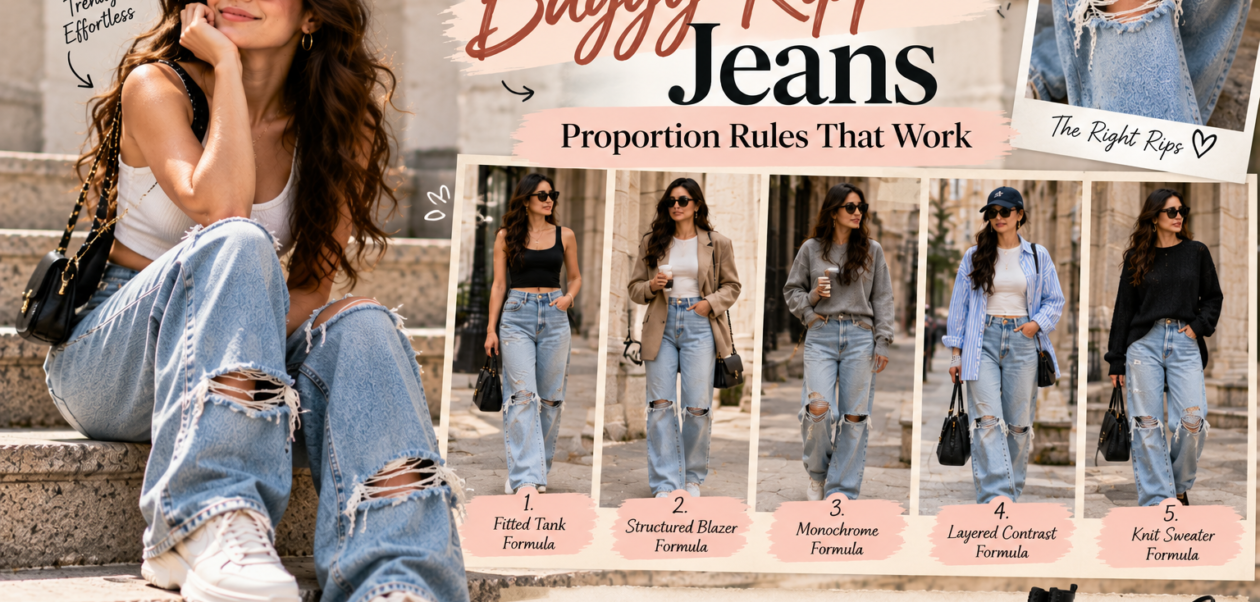
Five Outfit Formulas for Baggy Ripped Jeans
Here are the combinations I actually reach for, broken down so you can rebuild them with whatever you already own.
The fitted tank formula: a simple, snug tank top, your baggy ripped jeans, and clean sneakers. This is the easiest entry point into the silhouette, since the tank does all the proportion work with zero extra effort.
The structured blazer formula: an oversized or tailored blazer, a fitted tee or bodysuit underneath, baggy ripped jeans, and either minimal sneakers or a pointed flat. This is genuinely my favorite for anything slightly dressier, since the blazer’s structure counters the volume below perfectly.
The monochrome formula: baggy ripped jeans and a top in the same or a very similar tone, both grey, both a deep neutral, worn together. Keeping the palette unified actually makes the oversized silhouette read as intentional rather than mismatched.
The layered contrast formula: a tank top under a long tee, under a lightweight open layer, finished with your jeans. This adds visual interest through layering rather than through loose, bulky volume, which keeps the whole look from piling on even more bagginess. A simple top you already own usually works just as well here as anything new.
The knit sweater formula: a slightly fitted or ribbed knit, tucked or half-tucked, with baggy ripped jeans and boots. This is my go-to once the weather cools down, since a fitted knit gives you warmth without undoing the proportion balance.
Footwear: How Your Shoes Change the Whole Proportion
Shoes genuinely do more work in this silhouette than in almost any other outfit, since they’re grounding an unusually large amount of fabric above them.
Chunky sneakers or platform styles match the volume of baggy jeans and reinforce the relaxed, streetwear-leaning version of this look. I covered the proportion logic behind platform and chunky styles in more detail in my guide to fall outfits with sneakers, and the same balancing principle applies directly here.
Boots add structure and work especially well once the hem is cuffed or cropped enough to show them off. Delicate flats or thin-soled shoes, on the other hand, tend to get visually swallowed by all that extra denim, so they’re usually the weakest footwear choice for this particular silhouette, even though they work beautifully with other jean styles.
Hem Length and Cuffing: Getting the Bottom Right
Hem puddling, where excess fabric pools on the floor around your shoe, is one of the fastest ways to make baggy ripped jeans look like an accident rather than a styling choice.
A simple cuff or pin-roll at the ankle cleans up that excess length in seconds and lets your shoes actually show, which matters even more if you’ve invested in a great boot or sneaker to ground the outfit. Cropped baggy styles solve this automatically, showcasing your footwear by design rather than requiring any adjustment from you.
Getting your length right from the start, before you’re standing in front of the mirror trying to fix it, makes this a non-issue. It’s worth trying jeans on in the actual shoes you plan to wear them with, since a few inches of heel height or a chunky sole can change how much cuffing you actually need.
Baggy Ripped Jeans by Body Type
A few adjustments make this silhouette work beautifully across different frames.
For petite frames, a high-waisted style paired with a cropped top creates a cleaner, more proportional line, and heels or a platform sole help prevent the volume from overwhelming a smaller frame. For taller frames, the full length and volume of baggy ripped jeans is usually easy to carry without much adjustment at all, since there’s simply more height to balance the fabric against.
For curvier frames, waist definition becomes even more important, a belt or a front tuck creates the contrast that keeps the silhouette flattering rather than shapeless. For straighter builds, a structured jacket or a belt adds definition that the jeans alone won’t provide, giving the whole outfit a clearer shape.
Whatever your frame, the underlying principle stays the same: the more volume you’re wearing below the waist, the more intentional your waist definition needs to be above it. This is true of any relaxed-fit bottom wear, not just denim, so the skill genuinely transfers beyond this one silhouette.
Common Proportion Mistakes and Quick Fixes
A few small adjustments separate a baggy ripped jeans outfit that reads as styled from one that reads as sloppy.
| Mistake | Quick Fix |
| Oversized top with baggy jeans | Swap for a fitted or tucked-in top |
| Delicate, thin-soled shoes | Add a platform, chunky sole, or boot |
| No waist definition | Front tuck or add a belt |
| Hem puddling on the floor | Cuff or pin-roll the hem |
| Thin, flimsy denim | Choose a heavier weight, 12 ounces or more |
That last point is worth expanding on. Thinner denim doesn’t hold a baggy silhouette’s shape nearly as well as a heavier weight does, and it tends to look limp rather than intentionally relaxed. If you’re shopping for a new pair specifically for this silhouette, my denim vs cotton breakdown is worth a read to understand what you’re actually buying before you commit.
FAQs
1. How do I keep baggy ripped jeans from looking sloppy?
Balance the volume with a fitted or structured top, define your waist with a belt or tuck, and choose shoes with enough visual weight to ground the outfit, platforms, boots, or chunky sneakers all work well.
2. What tops work best with baggy ripped jeans?
Fitted tanks, structured blazers, and ribbed knits all create the contrast this silhouette needs. Avoid pairing an equally oversized top, since two loose pieces together erase your shape entirely.
3. Can petite women wear baggy ripped jeans?
Yes, with a few adjustments. A high-waisted style paired with a cropped top and heels helps create better proportion for a smaller frame.
4. Should I cuff baggy ripped jeans?
Often, yes. Cuffing or pin-rolling the hem prevents puddling at the ankle and lets your shoes actually show, which matters most if you’ve chosen a statement boot or sneaker.
5. What shoes work best with baggy ripped jeans?
Chunky sneakers, platforms, and boots all match the volume of the jeans and help anchor the outfit. Delicate, thin-soled shoes tend to get visually lost underneath this much denim.
6. Is a belt necessary with baggy ripped jeans?
Not strictly necessary, but genuinely helpful. Since baggy jeans sit away from your body, a belt or front tuck provides the waist definition that the jeans alone won’t give you.
7. Does denim weight actually matter for this silhouette?
Yes. Heavier denim, generally 12 ounces or more, holds a baggy shape better than thinner fabric, which tends to look limp rather than intentionally relaxed.
The Bottom Line
So there you have it, ladies: baggy ripped jeans genuinely come down to one core skill: balancing all that extra volume with structure and intention everywhere else in your outfit. Fitted tops, defined waistlines, and the right shoes do almost all of the work.
My honest advice is to pick just one formula from this guide and actually try it with pieces you already own before buying anything new. The silhouette itself is forgiving once you understand the proportion rule behind it, you really don’t need a brand new wardrobe to make it work, just a little intention about what you pair with the jeans you’ve already got.
Which formula are you trying first, the fitted tank or the structured blazer? Let me know in the comments, I’d love to hear which one fits your style best.
Happy styling, ladies!