Table of Contents
Hey lovely ladies! Can we talk about the closet phenomenon where you own twenty different “fall pieces” and somehow still stand there every morning feeling like you have nothing to wear? I’ve lived that exact frustration, a closet stuffed with sweaters, jackets, and boots that all looked great on their own but never actually talked to each other.
The fix wasn’t buying more. It was building fall fashion for women around a smaller set of pieces that genuinely work together, so one good sweater can become five different outfits instead of just one. Once I started thinking this way, getting dressed in autumn stopped being a daily negotiation and started being genuinely easy.
This guide isn’t a trend roundup, and it’s not about layering technique either, I’ve covered both of those elsewhere. This is specifically about the math behind a fall wardrobe that actually works, the pieces, the palette, and the formulas that turn a handful of items into a season’s worth of outfits, without you needing to buy a single new thing before you’ve actually taken stock of what’s already hanging in your closet.
The Fall Capsule Wardrobe Essentials
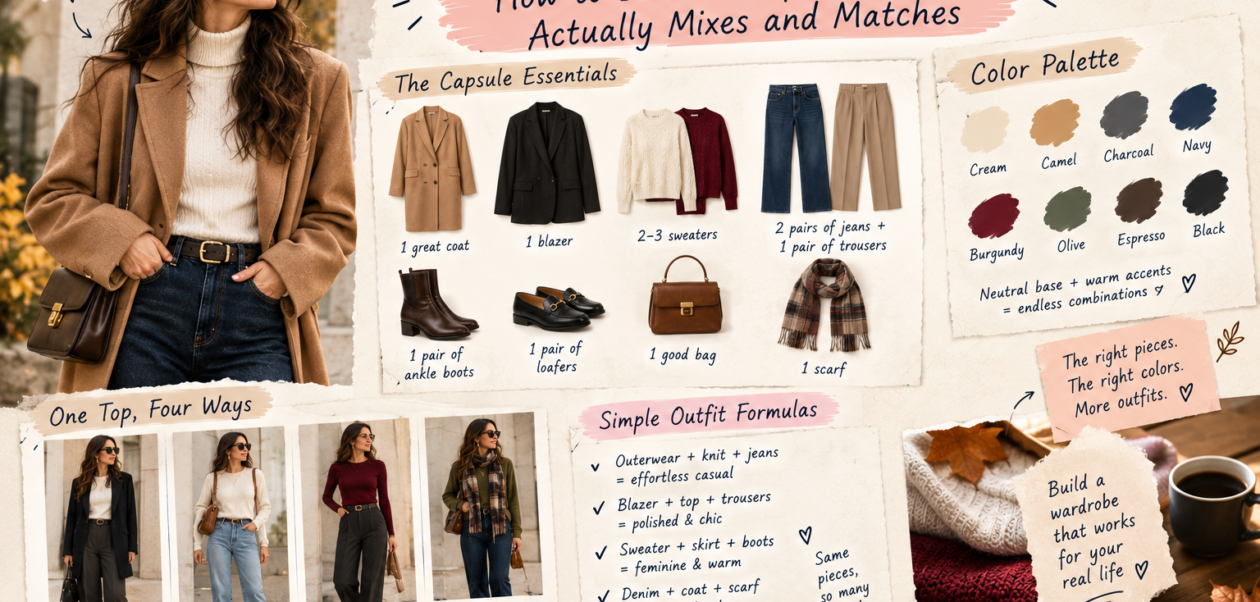
Before we get into formulas, let’s talk about the actual pieces worth having. A solid fall capsule usually breaks down into a handful of categories, and you genuinely don’t need a lot within each one.
One great coat, whether that’s a trench, a wool topper, or something in-between, sets the tone for your entire season. One tailored blazer works double duty for the office and for dressing up a casual outfit. Two or three sweaters in different weights and silhouettes, one fitted, one oversized, cover most temperature ranges.
A couple of well-fitting pairs of jeans, one tailored and dark for polish, one relaxed for weekends, round out your bottoms alongside a pair of trousers. One pair of ankle boots and one pair of loafers cover nearly every occasion you’ll actually face this season.
That’s a genuinely short list, and that’s the point. My honest take is that most people don’t have a fall wardrobe problem, they have a fall wardrobe mixing problem, too many pieces that were never chosen to work together in the first place. It’s a lot easier to fix a mixing problem than it is to fix a genuinely empty closet, which is honestly good news if you’re staring at a stuffed closet feeling like you have nothing to wear.
The Color Palette That Actually Works Together
A big part of why capsule pieces mix and match so easily comes down to color discipline. A well-built fall palette leans on neutral bases, cream, camel, charcoal, and navy, layered with a few warm accent tones like burgundy, olive, and espresso brown.
The trick is choosing your accent colors carefully and then sticking to them. If every piece you own can pair with at least two others in your closet, you’ve built a capsule instead of just a pile of individually nice clothes.
This doesn’t mean fall fashion for women has to be boring. A single statement piece, a burgundy sweater or an olive jacket, stands out precisely because everything around it is intentionally quiet. That contrast is what makes a simple outfit actually look put-together rather than just plain.
The Outerwear-First Approach
Here’s a genuinely useful mindset shift for fall dressing: choose your outer layer first, and build the rest of the outfit backward from there.
If your coat or jacket has a clear, strong silhouette, structured shoulders, a defined waist, a dramatic length, everything underneath can stay simple. A quiet base under a statement coat reads intentional, while a busy outfit under a busy coat just competes with itself.
This approach also makes shopping genuinely easier. Instead of buying pieces at random and hoping they’ll work together later, you’re building deliberately around the piece doing the most visual work. If you’re shopping for a new coat or jacket this season, think of it the same way you’d think about any other layering piece in your closet, as the anchor the rest of the outfit responds to.
One Top, Four Ways
This is my favorite formula for actually getting the most out of every piece you own, and it’s simpler than it sounds. Take one versatile top or sweater, and style it four completely different ways using what’s already in your closet.
Dressed for the office: tuck it into trousers, add a blazer, finish with loafers. Dressed for the weekend: pair it with relaxed jeans and sneakers, no blazer needed. Dressed up for dinner: tuck it into a skirt, add tights and ankle boots. Layered for a cold day: throw a cardigan over it with your favorite top as the visible base layer underneath.
If you genuinely only remember one idea from this whole guide, let it be this one. A single well-chosen piece styled four different ways is worth more to your closet than four mediocre pieces that only work one way each. Try this exercise on a sweater or top you already own before you buy anything new this season, you might be surprised how much mileage it actually has left in it.
Denim for Fall: Which Pairs Actually Earn a Spot
Denim is doing a lot of heavy lifting in most fall capsules, so it’s worth being intentional about which pairs you actually keep in rotation. One tailored, dark-wash pair that works for a dinner or a casual meeting is non-negotiable. One relaxed, comfortable pair earns its spot for weekends and errands.
Before you buy anything new, it’s worth understanding your actual measurements so you’re not guessing at fit. My inseam vs outseam guide walks through exactly how to measure yourself properly.
It’s also worth knowing what to expect once new denim actually gets worn and washed. My guide on how much jeans typically shrink is worth a read before you commit to a new pair specifically for the season, especially if you’re buying a deeper, heavier wash.
And if you’re deciding between true denim and a lighter cotton-twill alternative for one of your fall bottoms, my denim vs cotton breakdown covers exactly how those fabrics differ in feel and structure.
Fall Outfit Formulas for Different Occasions
Here’s how the pieces above actually come together depending on where you’re headed.
| Occasion | Formula |
| Office | Blazer + trousers or tailored jeans + loafers |
| Weekend errands | Sweater + relaxed jeans + sneakers or ankle boots |
| Date night | Fitted top + skirt or tailored trousers + heeled boots |
| Casual dinner out | Sweater dress + tall boots + a statement coat |
| Layering for cold days | Base layer + cardigan + structured outerwear |
My honest advice is to actually write out a version of this table using your own closet. Seeing your pieces organized by occasion, rather than just hanging randomly, makes it far easier to spot what’s missing and what you already have plenty of.
It also helps you shop with intention next time you’re tempted by something that catches your eye but doesn’t actually have an obvious place in your rotation.
Where to Splurge vs Where to Save
Not every fall piece deserves the same budget, so here’s how I’d think about allocating what you spend.
Splurge on your coat and your boots, since both get worn constantly and show visible wear fastest if they’re poorly made. Save on trend-driven pieces, a statement print top or a trendy accessory, since these have a shorter shelf life in your rotation regardless of quality. A great blazer sits somewhere in the middle, worth a moderate investment since it works so hard across both office and casual outfits.
If you’re building this out as a genuine long-term strategy rather than a one-season plan, it’s worth thinking of your whole approach the same way I’d frame any capsule wardrobe, invest in the pieces you’ll wear constantly, and treat trend pieces as low-cost experiments.
Common Mistakes When Building a Fall Wardrobe
A few habits quietly undercut an otherwise solid fall capsule, so let’s fix them.
Buying pieces in isolation, without thinking about what they’ll actually pair with, is probably the most common one. Before buying anything new, ask yourself what’s already in your closet that it would realistically work with.
Chasing every trend at once is another trap. Fall fashion for women doesn’t need to include every single micro-trend of the season. One or two intentional trend pieces layered into a solid foundation will always look more put-together than a closet trying to do everything at once.
Ignoring your bottom wear in favor of focusing entirely on sweaters and coats is a mistake too. Your bottoms need just as much intentional planning as your top half, especially since they’re doing double duty across both casual and dressier outfits.
Forgetting the transition period is a common oversight as well. Early fall still runs warm in a lot of places, and my guide on how to actually layer for genuinely cold weather is worth saving for once temperatures really drop, since fall dressing and deep winter layering call for a slightly different approach.
FAQs
1. How many pieces do I actually need for a fall capsule wardrobe?
A genuinely functional fall capsule can work with as few as fifteen to twenty pieces, including outerwear, tops, bottoms, and shoes, as long as everything is chosen to mix and match with everything else.
2. What colors work best for fall fashion?
Neutral bases like cream, camel, charcoal, and navy paired with warm accent tones like burgundy, olive, and espresso brown create a palette where nearly everything coordinates.
3. Should I choose my coat or my outfit first when getting dressed for fall?
Choosing your coat or outer layer first is genuinely a smarter approach. Let the outerwear set the tone and keep the layers underneath simple, rather than building outward from a busy base outfit.
4. How many pairs of jeans do I really need for fall?
Two solid pairs cover most situations, one tailored, dark-wash pair for dressier occasions and one relaxed pair for weekends and errands.
5. Where should I spend the most money on fall pieces?
Your coat and your boots are worth the biggest investment, since both get worn constantly and show wear the fastest if they’re poorly made.
6. How do I avoid buying pieces that don’t work with anything else I own?
Before buying anything new, mentally pair it with at least two pieces you already own. If you can’t picture real outfits forming, it’s probably not a genuine capsule addition.
7. What’s the easiest way to get more outfits out of pieces I already own?
Pick one versatile top or sweater and style it at least four different ways, dressed up, dressed down, layered, and worn solo, before assuming you need to buy something new.
The Bottom Line
So there you have it, ladies, real fall fashion for women isn’t about owning the most pieces, it’s about owning pieces that actually work together. A well-chosen coat, a couple of great sweaters, two solid pairs of jeans, and shoes that pull double duty will take you further than a closet full of one-off buys ever will.
My honest advice is to go through your closet this week and actually try the one-top-four-ways formula on something you already own. You might find you have more of a working fall wardrobe than you thought, just hiding behind a few gaps worth filling intentionally.
What’s the one fall piece you find yourself reaching for again and again? Tell me in the comments, I’m always curious what earns permanent rotation status in other people’s closets.
Happy styling, ladies!