
Table of Contents
Hey lovely ladies! Can we talk about the year I picked out the perfect strapless dress for an outdoor summer wedding, spent an hour on my makeup, and completely forgot sunscreen because I figured a few hours outside wouldn’t matter? I ended up with a tan line so sharp across my shoulders that it showed in every single photo from that day, and it took weeks to fade evenly.
That’s the day I actually learned the uses of sunscreen, not just as a beach-day afterthought, but as a real part of getting dressed.
Sunscreen is one of those things that’s easy to treat as optional once summer rolls around, especially when you’re focused on picking the right sundress or sandals. But the truth is, it belongs in the same category as your outfit planning, not separate from it.
Like the uses of toner I covered in an earlier post, this is a bit of a departure from our usual denim and closet content, but it’s genuinely part of how a great summer look actually holds up in real life, and in photos.
By the end of this guide, you’ll know exactly what sunscreen does, how it actually protects the skin your outfit shows off, and how to build it into your routine so a great summer look doesn’t come with an uneven tan line as a souvenir.
Quick note before we dive in: this is general information, not medical advice, so if you have specific skin concerns or a history of sun sensitivity, it’s always worth checking in with a dermatologist for personalized guidance.
What Sunscreen Actually Does
Sunscreen works by either absorbing or reflecting the sun’s ultraviolet rays before they can damage your skin. There are two types of UV rays that matter here: UVB rays, which cause sunburn, and UVA rays, which contribute to premature aging and also play a role in skin cancer risk.
A broad-spectrum sunscreen protects against both types, which is exactly why dermatologists consistently recommend looking for that specific label rather than just checking the SPF number. SPF, or sun protection factor, mainly measures protection against UVB rays specifically.
The research on this is genuinely striking. Studies show that regular daily sunscreen use can meaningfully lower the risk of certain skin cancers over time, alongside its more immediate benefits like preventing sunburn and slowing visible signs of aging like wrinkles and dark spots.
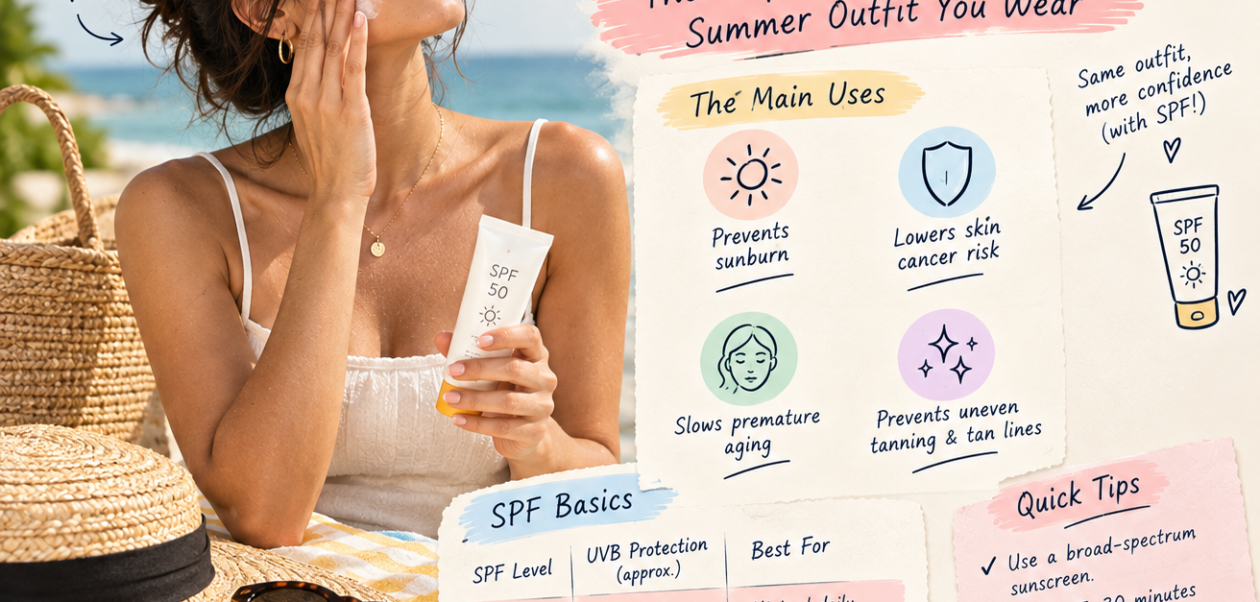
The Main Uses of Sunscreen You Should Know
Let’s break down what this step is actually accomplishing beyond the general “it protects your skin” idea.
Preventing sunburn is the most immediate, visible benefit, and it’s the one most people think of first. A bad sunburn doesn’t just hurt, it also makes wearing certain fabrics against your skin genuinely uncomfortable for days afterward.
Reducing skin cancer risk is the long-term benefit that matters most, even though it’s less visible day to day. Daily sunscreen use, applied consistently over years, is one of the most well-supported ways to lower that risk.
Slowing premature aging is the benefit that tends to motivate a lot of people day to day. Sun exposure is one of the biggest contributors to fine lines, sagging, and uneven pigmentation over time, so consistent sunscreen use is genuinely one of the most effective anti-aging habits available.
Preventing uneven tanning and tan lines is the one that ties most directly back to your closet. Inconsistent sunscreen application, missing a strap line here or a shoulder there, is exactly how those sharp, hard-to-fix tan lines happen in the first place.
SPF Basics: What the Numbers Actually Mean
The SPF number on your sunscreen bottle tells you roughly how much longer you can be in the sun before burning, compared to wearing no protection at all, though the real-world difference between levels is smaller than most people assume.
| SPF Level | Approximate UVB Protection | Best For |
| SPF 15 | About 93% | Minimal daily exposure, mostly indoor days |
| SPF 30 | About 97% | Everyday wear, errands, daily commute |
| SPF 50 | About 98% | Extended outdoor time, beach days, events |
| SPF 50+ | Slightly higher, marginal gains | Prolonged sun exposure, fair or sensitive skin |
My honest advice: don’t get too caught up chasing the highest SPF number on the shelf. The bigger factor in how well sunscreen actually protects you is applying enough of it and reapplying consistently, not just the number on the bottle.
How Sunscreen Interacts With What You’re Actually Wearing
This is where sunscreen and your closet genuinely intersect. The amount of skin your outfit exposes should directly influence how much sunscreen you’re applying and where.
A strappy sundress, an off-shoulder top, or anything with a low back needs sunscreen applied specifically to those exposed areas, not just your face. If you’re building your summer looks around pieces like a camisole, remember that the same shoulders and chest a cami shows off are exactly the areas most likely to get missed during a quick sunscreen application.
Sheer or lightweight fabrics also let more UV light through than people expect. A thin cotton or linen top offers some protection, but nowhere near what a proper sunscreen application does underneath it, especially for a fabric worn all day out in direct sun.
Can Your Clothes Do Some of the Work Too?
This is genuinely one of my favorite intersections between fashion and skin health. Fabric can actually provide meaningful sun protection on its own, and it comes down to some of the same fabric knowledge that matters for fit and drape.
Tighter weaves and heavier fabrics generally block more UV light than loose, thin ones. This connects directly to understanding fabric weight, or GSM, since a densely woven, heavier cotton or linen piece genuinely offers more built-in sun protection than a sheer, lightweight version of the same garment.
Some clothing is specifically rated with a UPF number, or ultraviolet protection factor, similar in concept to SPF but measuring how much UV light a fabric blocks. If you’re planning a lot of time outdoors this summer, a UPF-rated cover-up or layering piece is a genuinely smart addition alongside sunscreen, not a replacement for it.
A wide-brim hat is another easy win here, and if you’ve been building out any kind of western-inspired look already, you likely already own the exact accessory that does double duty as both a style statement and genuine sun protection for your face and scalp.
How to Apply Sunscreen the Right Way
Application technique matters more than most people realize, and it’s honestly where most sunscreen falls short of its labeled protection.
Apply about a shot glass worth of sunscreen to cover your body, and a nickel-to-quarter-sized amount specifically for your face and neck. Most people apply only a fraction of this amount, which means they’re getting far less protection than the SPF number on the bottle suggests.
Apply about 15 to 30 minutes before heading outside, giving your skin time to actually absorb the product before sun exposure starts. If sunscreen is layered into your makeup routine, apply it after your other skincare but before makeup for the best results.
Reapply every two hours, and immediately after swimming, sweating heavily, or toweling off, regardless of how high the SPF is on the label. A higher SPF doesn’t mean you can skip reapplication, it just means slightly better protection during the time between applications.
Don’t forget commonly missed spots. Ears, the back of your neck, the tops of your feet if you’re wearing sandals, and your hairline are all easy to overlook, especially if you’re moving quickly while getting ready.
Sunscreen for Different Summer Occasions
Just like your outfit changes depending on where you’re headed, your sunscreen approach should shift a little too.
For everyday errands, a lightweight facial sunscreen under your regular makeup routine is usually enough, especially if most of your body stays covered by your regular tops and bottoms during the day.
For a beach day or pool party, go heavier and more frequent. Water-resistant, broad-spectrum sunscreen applied generously before you head out, then reapplied every couple hours, matters far more here than on a typical errand day, especially paired with whatever bottom wear or swimwear leaves the most skin exposed.
For an outdoor event, like a summer wedding or garden party, apply sunscreen early enough that it’s fully absorbed before you start makeup, and reapply discreetly if the event runs several hours, especially on your shoulders and chest if you’re wearing anything strapless or sleeveless.
Common Sunscreen Mistakes That Undo Your Prep
A few habits quietly reduce how well your sunscreen actually protects you, so let’s fix them.
Applying too little is the most common mistake, and it’s why most people get far less protection than their SPF label promises. When in doubt, apply more generously than feels necessary.
Skipping reapplication is another big one, especially on long outdoor days. Sunscreen naturally breaks down over time and wears off from sweat, water, and simply touching your skin throughout the day.
Only applying to your face is a mistake that directly connects back to your outfit choices. If you’re wearing anything that exposes your shoulders, chest, back, or legs, those areas need the same attention your face gets.
Assuming cloudy days don’t require sunscreen is a common misconception too. UV rays pass through cloud cover more than people expect, so skipping sunscreen on an overcast day still leaves your skin exposed to meaningful UV damage.
FAQs
1. What are the main uses of sunscreen?
Sunscreen protects against sunburn, reduces long-term skin cancer risk, slows premature aging like wrinkles and dark spots, and helps prevent uneven tanning and tan lines.
2. What SPF should I actually be using day to day?
Dermatologists generally recommend SPF 30 or higher for daily wear, and SPF 50 or higher for extended outdoor exposure like a beach day or outdoor event.
3. Can my clothing replace sunscreen?
Not entirely. Tightly woven, heavier fabrics and UPF-rated clothing provide meaningful protection, but sunscreen is still necessary for any exposed skin your outfit doesn’t cover.
4. How often should I reapply sunscreen?
Every two hours, and immediately after swimming, heavy sweating, or towel drying, regardless of the SPF level on the label.
5. Do I need sunscreen on cloudy days?
Yes. UV rays pass through cloud cover more than most people realize, so your skin is still exposed to meaningful UV damage even without direct sunlight.
6. Why do I keep getting uneven tan lines even when I wear sunscreen?
This usually comes down to missed spots or inconsistent reapplication, especially around straps, necklines, and areas your outfit exposes only when you move or shift position throughout the day.
7. Should I apply sunscreen before or after makeup?
Apply sunscreen after your regular skincare routine but before makeup, giving it roughly 15 minutes to absorb so it can do its job properly underneath everything else.
The Bottom Line
So there you have it, ladies, the real uses of sunscreen go well beyond avoiding a sunburn on a beach day. It’s protecting the same skin your favorite summer outfits are designed to show off, and building it into your routine the same way you plan your outfit means fewer uneven tan lines and healthier skin in the long run.
My honest advice is to treat sunscreen the same way you’d treat picking your shoes for an outfit, it’s a non-negotiable part of getting dressed for the sun, not an optional extra step you can skip when you’re in a hurry.
If you’re building out a full summer rotation, it’s worth thinking about sun protection the same way you’d think about any other capsule wardrobe essential, something you reach for automatically rather than something you remember only when it’s already too late.
Have you ever had a tan line disaster ruin a great outfit? Tell me about it in the comments, I promise mine from that wedding was rough enough to make you feel better about yours.
Happy styling, ladies!